
Opportunity data was scattered
Tenders, procurement notices, and investment projects were published across separate federal and provincial sources. Users had to search each source independently.
Users can search investment projects, tenders, and procurement notices collected from Canadian sources in one portal.
Anthropic’s Claude models organize records by sector, province, and opportunity type, with uncertain records sent for review.
Users can save searches and alerts, while admins manage sources, review records, and control what gets published.
About the client
Manifold Growth Partners is a quantitative investment firm that helps investors optimize their portfolios for consistent returns, independent of conventional market trends.
Manifold wanted to create a simpler way for global investors and companies to discover opportunities in Canada. The information they needed was scattered across federal, provincial, and municipal sites with no shared format.
Manifold brought in Gyde to build the discovery layer that made that diversification workable: one platform where investors could find, filter, and get alerted to Canadian opportunities that matched their sector and risk profile.
The problem statement
Tenders, procurement notices, and investment projects were published across separate federal and provincial sources. Users had to search each source independently.

Provincial registries contained thousands of projects, many of which did not match Manifold’s investment and supply objectives.

Dates, province names, sector labels, encodings, and record structures varied across sources, making reliable searching difficult.

Investors and suppliers needed simple search and alerts. Admins needed source management, review queues, and control over publication.
How Gyde solved it
Manifold and Gyde agreed on the types of investment projects, tenders, and procurement notices that global investors and companies needed to find.
A nightly worker collects new records from the connected sources, corrects inconsistent dates and province labels, and sorts notices by date before processing them. It also skips unchanged records, keeping older data from repeatedly entering the AI workflow.
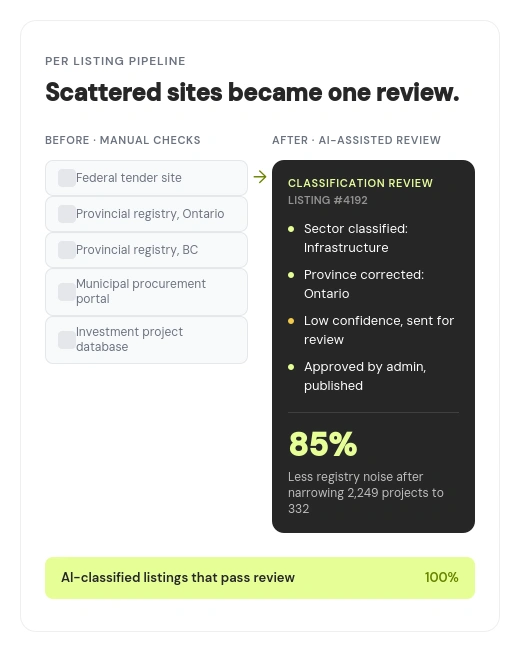
Two provincial registries contained 2,249 projects. Filtering for industrial, infrastructure, and energy projects above $50 million narrowed these to 332 targeted listings rather than filling the portal with unrelated projects.
Gyde uses Anthropic’s Claude models for different tasks: Haiku for routine classification, Sonnet for a second opinion on ambiguous records, and Opus for drafting summaries and newsletters. The AI helps organize information; it does not decide what gets published.
Administrators review the suggested sector, province, opportunity type, and summary. They can approve, edit, or reject a record before users see it.
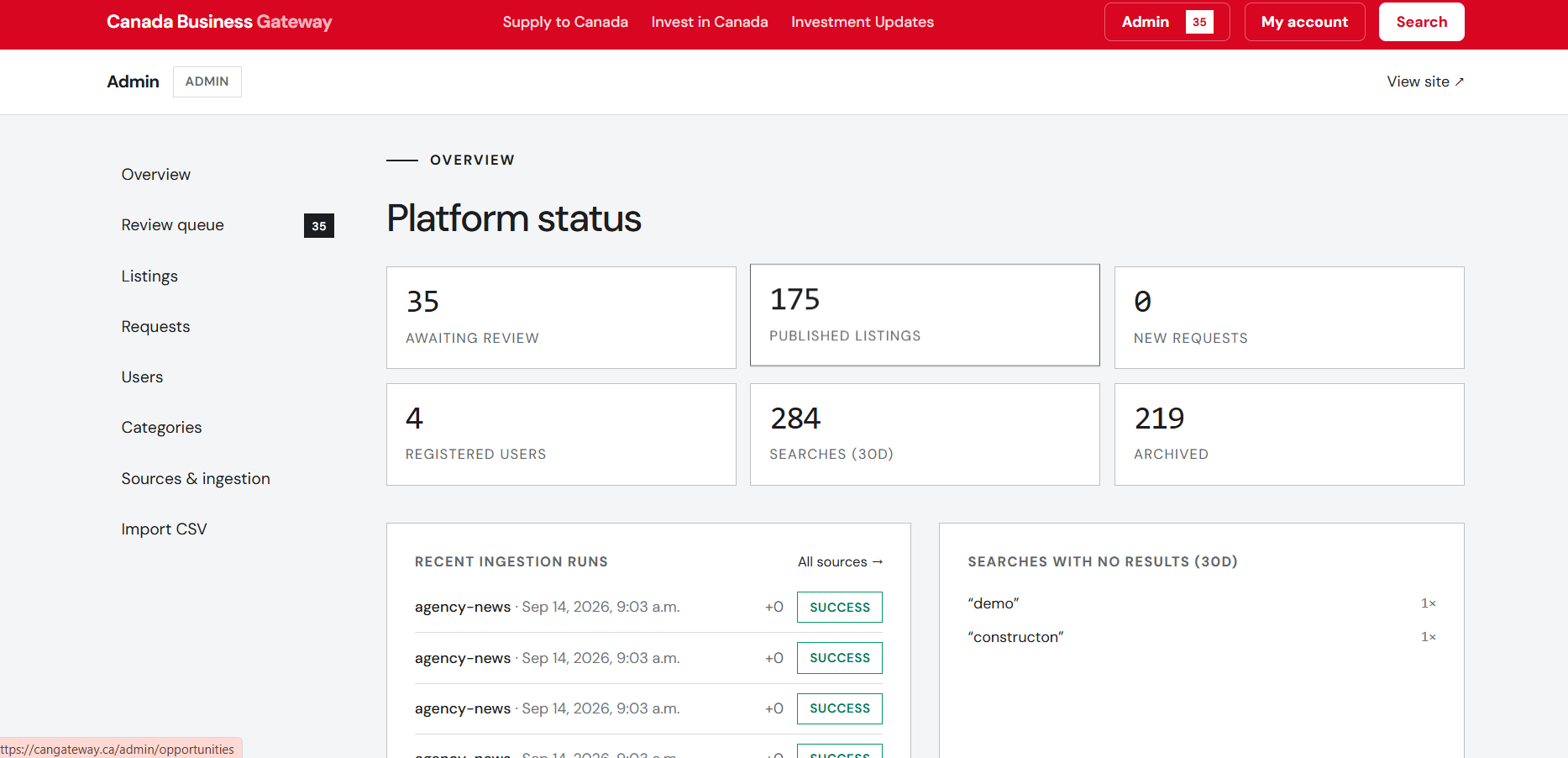
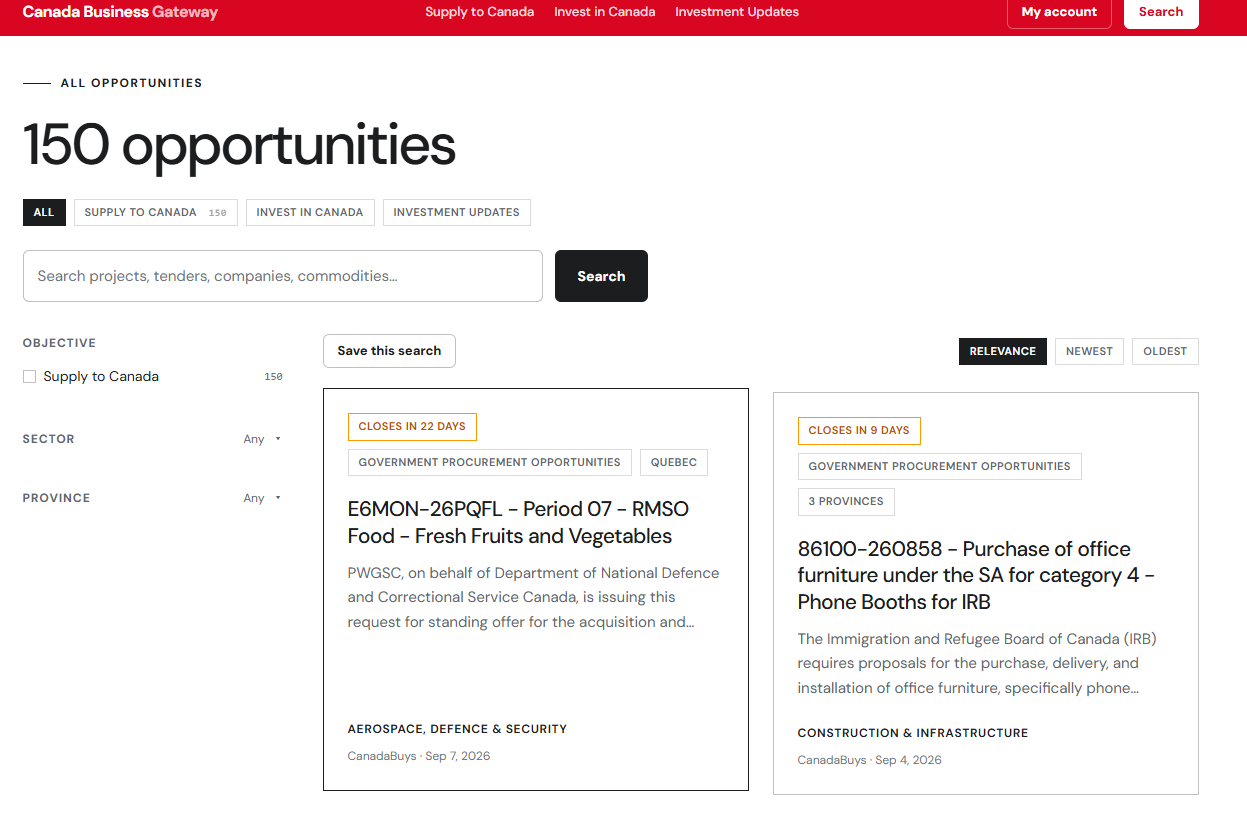
Investors and suppliers can search, filter, save, and share opportunities through links that preserve their chosen filters. Administrators have a separate workspace to manage sources, reviews, interests, alerts, and published listings.
The outcome
Checking a dozen-plus government and agency sites by hand
One platform, personalized alerts, role-based access for investors and admins
17,000+ lines of TypeScript across six packages
No consistent way to verify a listing's classification before acting on it
Every listing re-validated against its schema, then reviewed by a person before it publishes
174 tests, including migrations run against a database
Processing cost that would grow with the size of the whole corpus
Cost tied to new or changed content only, via the hash-and-skip step
~$60/month estimated for classification at current volumes
The pattern behind the result
A record placed in the wrong sector can become invisible to the person looking for it. Classification quality directly affects whether users find useful opportunities.
AI organizes and summarizes records, but administrators control publication. Thin, ambiguous, or low-confidence records remain in the review queue until someone checks them.
Moving from 22 sectors to 13 required updates across listings, prompts, filters, user interests, alerts, and saved searches. Retain older sector codes as tags so you don't lose previous information.
In their words
We did not want to put more listings in front of people. We wanted investors and suppliers to find Canadian opportunities that matched what they were looking for. Gyde helped bring information from scattered sources into one portal and make it easier to search. It gives us a foundation we can expand as we connect more sources.

Explore more success stories
Gyde can help you turn it into a focused AI system with clear data sources, review rules, model choices, and a practical production boundary.