
Uncertainty Across Process Steps
The lead-to-loan journey involved multiple stages, inputs, and checkpoints. When employees encountered an error, they couldn't always identify what went wrong, which step to revisit, or how to proceed correctly.

Step-by-step guidance built into QDE, DDE, legal, and underwriting workflows
Real-time help exactly where an agent gets stuck, no ticket required
Walkthroughs and videos built for the field, not just the desktop
About the client
Grihum Housing Finance Limited, formerly Poonawalla Housing Finance, is a national affordable housing finance company registered with the RBI and backed by TPG Group. It serves low- and middle-income borrowers across 200-plus branches in 18 states and union territories.
Supporting a distributed workforce across a multi-stage lending process made consistent execution an ongoing operational priority, not a problem that one-time training could solve. That was the gap Grihum needed to close before Gyde.
The problem statement
The lead-to-loan journey involved multiple stages, inputs, and checkpoints. When employees encountered an error, they couldn't always identify what went wrong, which step to revisit, or how to proceed correctly.

Sales, legal, and underwriting teams handled different parts of the process across QDE, DDE, and other internal tools. Without a common guidance layer, each team had to understand its own steps and the requirements for the next handoff.

A significant part of Grihum’s workforce completed processes through mobile devices while working in the field. Traditional training materials and desktop-based support were hard to access when employees needed help.

When employees were unsure how to complete a step, they frequently turned to their managers for help. Repeated process questions increased the support burden on managers and left field teams waiting for answers before they could continue.
How Gyde solved it
A Grihum process specialist demonstrated the steps, decision points, common errors, and hand-offs involved across sales, legal, and underwriting. This helped the team build workflow guidance, rather than relying only on process documents or assumptions.
Gyde used its AI-powered Walkthrough Creator to convert recorded processes into structured, step-by-step guidance. The tool identified the action sequence and created the initial walkthrough framework, reducing the manual effort needed to build each flow from scratch.
The team developed the guidance module by module. Sales, legal, and underwriting teams reviewed the walkthroughs created for their respective stages. Their sign-off ensured the instructions reflected the correct process, terminology, and operational requirements before the team made them available to employees.
Assist mode gave employees contextual support within the application they were already using. When they were unsure about a field, action, or next step, they could access relevant guidance without leaving the workflow to search through separate documents or training material.
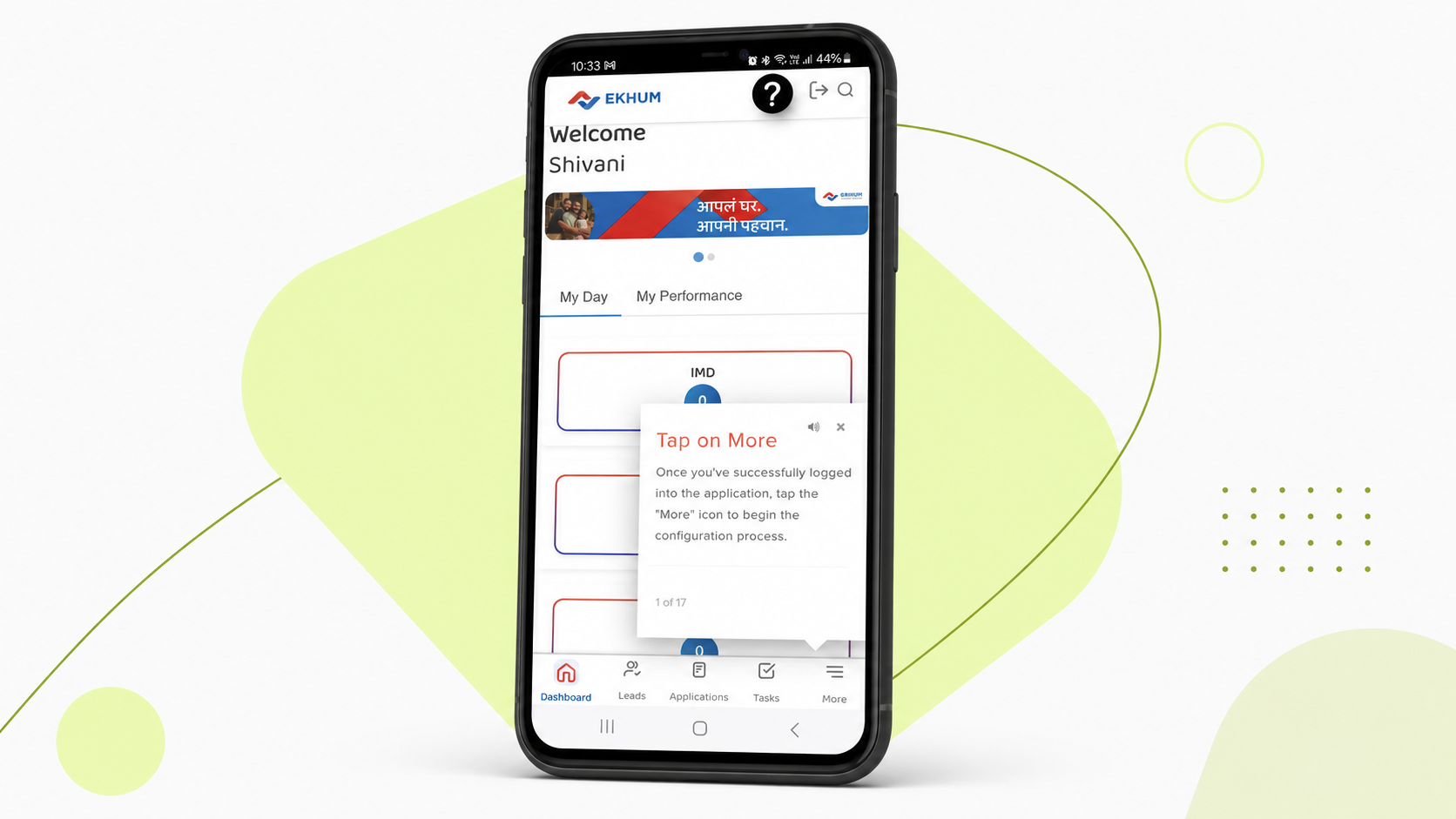
Because many employees worked in the field, Gyde added walkthroughs and support videos to Grihum’s mobile application, so employees could access help while completing tasks on the go, using a movable Gyde widget that field agents can reposition so it never blocks a menu or field on screen.
The outcome
Employees searched for help outside the application
Contextual guidance became available within the workflow
Process knowledge varied across teams and locations
Verified walkthroughs created a shared source of guidance
Field support was difficult to access on mobile
Walkthroughs and videos became available within the mobile application
Routine questions depended on manual support
support Assist mode helped employees resolve common process questions independently
What other BFSI teams can learn
Effective in-app support begins with understanding how work actually moves through the organization. Reviewing the workflow in UAT helped uncover decision points, common errors, and hand-offs that may not have been visible in process documents alone.
Guidance for regulated workflows cannot be created and published without operational review. Giving each team responsibility for validating its modules created clear ownership over the instructions employees would follow.
Guidance is only useful when it fits the environment in which employees work. Device type, screen space, and access at the moment of execution all influence whether employees can use that guidance consistently.
Explore more success stories
See how Gyde builds guidance directly into the systems your field and back-office teams already use.